
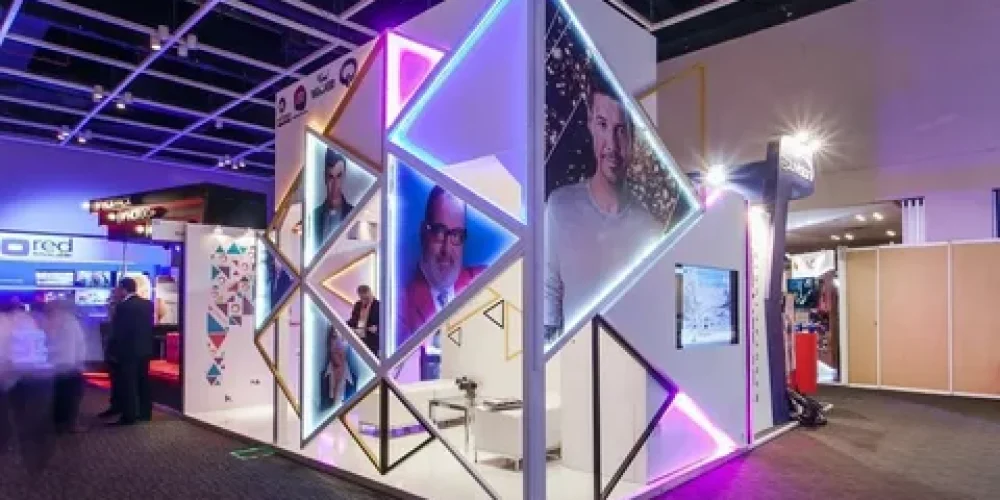
Exhibition booths that generate the most leads combine clear messaging, visible design, relevant demonstrations, and a simple way for visitors to take the next step. A large or visually impressive stand cannot guarantee results if attendees struggle to understand the offer, find the right information, or speak with someone who can help. Effective exhibition stand design connects attention with a useful conversation and a measurable follow-up action.
Experience in exhibition stand design, fabrication, installation, and live event delivery shows why lead generation depends on more than appearance. The strongest approach starts with the target audience, builds the stand around visitor needs, and prepares the team to qualify interest. These principles help exhibitors make better decisions before the event and evaluate performance afterward.
What Makes an Exhibition Booth Generate More Leads
Communicate One Clear Message
Visitors often make quick decisions about which stands deserve their attention. A headline should explain what the business does or what problem it solves without requiring a lengthy conversation. Supporting graphics should reinforce that message rather than compete with it.
Place the main message where approaching visitors can read it easily. Use concise text, strong contrast, and a clear visual hierarchy. Keep detailed product specifications, case studies, and technical explanations for conversations or dedicated displays.
Bonus tip: Ask someone unfamiliar with the business to look at the stand design for five seconds. If that person cannot explain the main offer, simplify the message before approving production.
Design for Visitor Movement
A booth can attract attention but still lose leads if its layout creates congestion or makes visitors feel trapped. Open entrances, clear sightlines, and accessible demonstration areas encourage people to approach naturally. Staff should be able to welcome visitors without blocking the main route.
Plan separate areas for browsing, short conversations, and more detailed discussions where the stand size allows. Position storage, cables, and equipment away from visitor paths to maintain a clean, professional environment.
Give Visitors a Reason to Stop
Static graphics explain an offer, but an interactive experience can help visitors understand its practical value. A product demonstration, working prototype, digital presentation, or focused sample display gives attendees a specific reason to engage.
Choose an activity that answers a genuine customer question. Avoid technology that attracts crowds without identifying potential customers. A busy booth is not necessarily a productive booth if visitors leave without understanding the offer or taking a next step.
Exhibition Stand Features That Influence Lead Generation
Different stand formats and design features support different visitor behaviours. Select them according to the event objective, audience, available space, and staffing requirements.
| Booth option or feature | Main advantage | Potential limitation | Best use |
|---|---|---|---|
| Open-plan custom stand | Flexible layout and clear access | Requires careful planning to avoid empty or poorly defined areas | Brands seeking tailored visitor journeys |
| Modular exhibition stand | Adaptable components and repeat use | Fixed modules can restrict unusual layouts | Businesses attending recurring exhibitions |
| Double-deck exhibition stand | Adds an elevated meeting or hospitality area | Requires structural planning, venue approval, and suitable access | Exhibitors needing separate public and private zones |
| Interactive product demonstration | Shows practical value directly | Requires reliable equipment and trained staff | Technical products and complex services |
| Digital screens | Present changing content and demonstrations | Poorly planned motion can distract from the main message | Product explainers and visual storytelling |
| Private meeting area | Supports focused qualification and detailed discussions | Can reduce open space if oversized | Business-to-business sales and longer buying cycles |
Use Measurable Design Specifications
Design decisions should follow the exhibition organiser’s technical manual rather than assumptions about what will fit. The following table identifies practical factors to confirm before production.
| Design factor | What to establish | Why it matters |
|---|---|---|
| Stand dimensions | Allocated width, depth, height, and permitted structure limits | Prevents layout conflicts and approval issues |
| Sightlines | Visibility from aisles and neighbouring stands | Helps visitors recognise the booth from a distance |
| Lighting | General illumination, product lighting, and screen visibility | Improves readability and directs attention |
| Power and connectivity | Equipment loads, socket positions, and network needs | Reduces demonstration failures |
| Accessibility | Entrance clearance, circulation, and accessible routes | Makes the stand easier for more visitors to use |
| Lead capture | QR codes, digital forms, badge scanning, or CRM integration | Helps staff record and organise enquiries |
| Demonstration capacity | Expected group size, viewing distance, and session duration | Reduces crowding and improves participation |
Turn Visitor Attention Into Qualified Leads
Attraction is only the first stage. A lead-generation process should help staff identify relevant visitors, understand their needs, and agree on an appropriate next step.
Train the team to ask concise, useful questions rather than immediately delivering a sales pitch. Questions about the visitor’s role, current challenge, project stage, or decision-making timeline can help distinguish general interest from a genuine business opportunity.
Give every meaningful conversation a clear outcome, such as a product demonstration, a follow-up meeting, technical information, or a scheduled callback. Record that outcome before moving to the next visitor.
Bonus tip: Use a short lead qualification checklist with consistent fields. Consistent records make post-event prioritisation more reliable than collecting business cards without context.
Measure Results Beyond Footfall
Exhibitor performance should be assessed against the original objective. Lead volume matters, but relevance and follow-up quality often reveal more about whether the stand worked.
The Center for Exhibition Industry Research (CEIR) publishes research on exhibition performance and attendee behaviour. Its industry research provides a useful starting point for understanding why event objectives and measurable outcomes matter. Consult the original research and its methodology before applying any benchmark to a specific exhibition.
For broader marketing context, the Content Marketing Institute’s annual research explores how marketers use content to engage audiences and support business goals. Its findings can help inform the educational materials and demonstrations used at an exhibition, although content marketing results should not be treated as direct exhibition lead-generation benchmarks.
Track the measures that match the event’s purpose:
| Performance measure | What it reveals | How to use it |
|---|---|---|
| Meaningful conversations | Whether the booth attracts relevant engagement | Compare with the event objective |
| Qualified leads | Whether visitors match the target customer profile | Assess lead quality rather than volume alone |
| Demonstration participation | Whether the experience encourages deeper interest | Refine demonstrations and scheduling |
| Meetings booked | Whether conversations lead to agreed actions | Review meeting quality and attendance |
| Follow-up response rate | Whether leads remain engaged after the event | Improve message relevance and follow-up timing |
| Sales-qualified opportunities | Whether exhibition contacts progress into the sales process | Evaluate longer-term business outcomes |
Avoid comparing exhibitions using raw lead counts alone. Audience composition, event duration, stand position, product relevance, and sales-cycle length can all influence results.
Prepare for Dubai’s Exhibition Conditions
Dubai exhibitions require attention to venue regulations, environmental conditions, and equipment reliability. Loading procedures, approved construction periods, access restrictions, and height limits vary by venue and event, so the organiser’s current technical manual should guide every production decision.
For events in warm conditions, plan for transport, storage, and installation periods that may expose equipment to heat. Protect sensitive electronics, check ventilation requirements, secure cable runs, and test displays under the expected operating conditions. Indoor halls may be climate-controlled, but logistics and loading areas can present different conditions.
Bonus tip: Schedule a complete technical rehearsal before opening. Test every screen, QR code, demonstration, network connection, and lead-capture method using the actual equipment intended for the show.
Things to Consider Before Choosing a Booth Design
Before approving a concept, confirm the following priorities:
- Audience: Identify the roles, industries, and customer needs the stand must serve.
- Primary objective: Decide whether the event should generate qualified leads, book meetings, launch a product, or build awareness.
- Visitor journey: Map how attendees will notice the stand, enter, engage, and take the next step.
- Operational requirements: Check venue rules, power access, installation schedules, storage, accessibility, and technical support.
- Team readiness: Match staffing levels and expertise to expected visitor activity.
- Measurement: Define lead qualification criteria and follow-up responsibilities before the exhibition begins.
A design that looks impressive in a rendering may perform poorly if it ignores these operational details.
Exhibition Stand Services That Support Lead Generation
LIVE EVENTS provides related exhibition and event services that address the practical elements of stand performance:
- Creative Exhibition Stand Design: Develops the layout, messaging hierarchy, and visitor journey around the event objective.
- Exhibition Stand Fabrication: Translates the approved design into physical structures, finishes, and display elements.
- Exhibition Stand Installation: Coordinates on-site assembly and setup in line with the venue’s requirements and schedule.
- Event Technologies: Supports digital displays and interactive elements used to demonstrate products and engage visitors.
Common Questions Before Choosing an Exhibition Booth
Should the stand focus on branding or lead generation?
Both can work together, but the main objective should determine the layout. A lead-focused stand needs clear messaging, accessible staff, useful demonstrations, and an easy capture process. A brand-awareness stand may place greater emphasis on visual storytelling and broad audience reach.
Are interactive features always worth including?
No. Include an interactive feature only when it helps visitors understand the product, explore a relevant problem, or start a meaningful conversation. Test usability and reliability before the event.
How can a small exhibition stand compete with a larger one?
A smaller stand can use a focused message, efficient layout, strong visibility, and well-prepared staff. Prioritising relevant conversations often matters more than filling the space with decorative elements.
When should the stand design be finalised?
Finalise the design early enough to obtain venue approvals, coordinate production, confirm technical requirements, and test any demonstrations. The exact lead time depends on the event’s complexity and organiser deadlines.
How to Improve Exhibition Booth Performance After the Event
Review lead records, staff feedback, visitor questions, demonstration engagement, and follow-up outcomes after the exhibition. Identify which messages attracted the right audience, where visitors encountered friction, and which conversations progressed into genuine opportunities. Apply those findings to the next stand rather than repeating the same layout without evidence.
For exhibition planning and technical coordination, LIVE EVENTS can be contacted at contact@liveevents.ae or +971 52 840 9669. Evaluate the audience, venue requirements, and business objectives first, then choose a stand design and engagement process that support those priorities.